
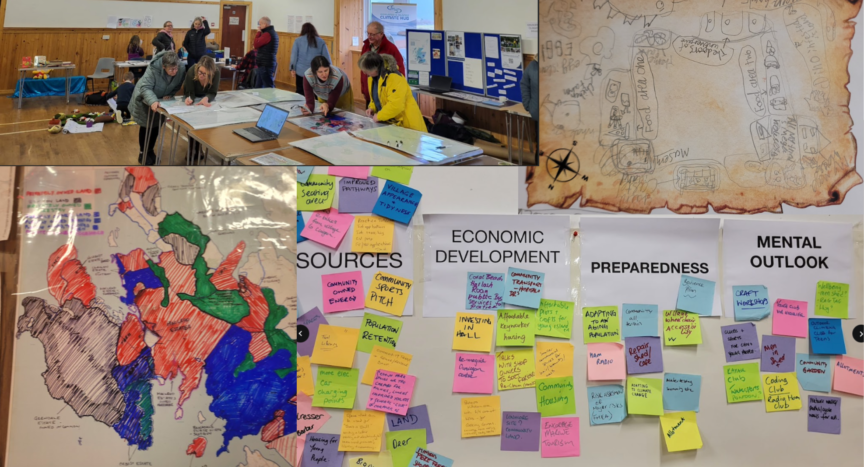
It’s very easy to become blinkered, by our own personal circumstances, or in terms of DCT and its volunteers and staff – by the projects we are working on (which can often take years to progress) and what our own interests are. The best remedy to this is to listen and talk wide a wide variety of people, to hear their experiences, and the Community Action Plan work has provided an excellent opportunity to do this in quite a structured way. Something which came up in nearly every one of the 14 face to face events we’ve held over the last year, more frequently than we expected, has been transport. Getting around – to work, to socialise, to attend essential appointments- is a constant issue for anyone who can’t drive or doesn’t have a car, whether that’s due to age , disability or any other reason. 53% of us don’t live within OUR comfortable walking distance of a bus stop, and the bus timetables are wholly impractical for a lot of journeys and types of trip(there is no public transport available that makes it possible for someone with mobility issues to nip to the local shops). Although most of us do have access to a car, we rely on them heavily – what would we do if we became unable to drive? 75% of us drive to Portree at least once a week – how are our lives affected by fluctuations in fuel prices, something outwith our control?
Getting around even WITH a car can be a challenge, as anyone who lives or works in Claigan or Glendale can attest to! In part due to the lack of provision of public transport, the vast majority of the 300,000 visitors to the North West are traveling everywhere by car, often on roads carrying far more traffic than they were designed to.
This isn’t a resilient or sustainable picture, but it is also one which we can work to improve, as many communities across Scotland have. For the rest of 2025 we will be looking at what the issues are, what potential solutions are, what the barriers and challenges to solutions might be, and how we could develop something that works here. What can we do right now to make a difference, and what long term solutions can we start working on to move to a different scenario in 5 and 10 years time? Examples of what other communities have done, and suggestions which have been made over the course of the CAP are listed below, and bear in mind they aren’t necessarily easy or perfect solutions. We need to ask ourselves too – what do we want to organise in community and what do we want to lobby Highland Council to provide, or partner on?
- Community Car – Sleat Trust manage an electric community car, which is owned and insured by Highland Council, and can be hired for trips. This requires support from Highland Council and a bank of volunteer drivers, in order to make it available to people who cannot drive themselves (the furthest these trips tend to go are to Portree.) Those hiring can drive themselves or request a volunteer driver.
- Car share – this relies on a bank of volunteers driving their own cars, and drivers are given a payment per mile.
- Subsidised taxi scheme – schemes like this identify an eligible cohort of the community and subsidise taxis for them for specific purposes. It could be used for medical appointments, or for meeting public transport links, or for work.
- Shuttle Bus – It’s been suggested that a shuttle bus, available to residents and visitors, could run from Lonmore, making stops through the village and the castle, turning around at the Coral Beach continuing throughout the day. This could ease some of the congestion in the village and Claigan, as well as mean people at the edge of the village could nip to the shops without the need to walk or take their car. This option would require much more physical and social infrastructure – the most obvious barrier being land – it would require a significant car park space, as well as management, licensing, permits, training, drivers and multiple minibuses.
- Township routes – A viable shuttle bus could in turn subsidise a minibus route around the townships to bring people to and from Dunvegan.
We’ve already gathered a lot of local information and views through the Community Action Plan Survey, and the publicly available stats for the area (See Skye Traffic). The next few months will be spent fleshing that out. To fully explore the options we’ve engaged Jenny Milne of SRITC and Rachael Milne of North East Transport Training guide us through the process of examining our current challenges, legislation, and required infrastructure and funding to create a model that we can work towards. Two elements which will inform this work will be:
- online visitor survey will be launching next week, open for the next 2 months looking at visitors experience and views of transport in the NW. This is particularly relevant in terms of feasibility of a Shuttle bus. We’re going to share this widely online and also QR codes at visitor hotspots, and ideally in accomodation providers, and cafes and restaurants too. This survey can be completed by anyone who has visited the area in the last 5 years, so not restricted to people here currently.
- We’ve invited representatives from local groups, landowners, business reps, as well as national organisations and representatives from NHS Highland and The Highland Council to come together in October at Dunvegan Hall to to thrash out what we need, what has been tried in the past (what works and doesn’t work) , what can be done now and in the future, and who can help us do it. If you haven’t received an invite and you think you should have, please email us office@dunvegantrust.co.uk
In terms of the visitor survey, it would be hugely helpful to have hospitality businesses and accommodation providers sharing the visitor survey with current or historic guests, if you have mailing lists.
We’ll also be available for a few dates in September TBC at Dunvegan Community Cafe for anyone who would like to have a chat about transport, and always available at hello@dunvegantrust.co.uk